


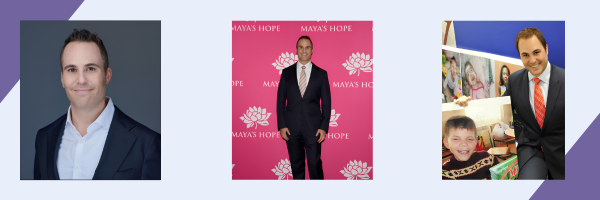
As a veteran wealth manager at Tocqueville Asset Management, Michael Meltzer knows philanthropy isn’t just a post-script to a financial plan, but an integral part of the equation. Indeed, philanthropy is a core value in his approach and central to his mission.
With over two decades of experience, Michael has seen firsthand how the right financial instruments can transform a complex tax liability into a win for charitable organizations. But his journey into the world of philanthropy and giving began long before he was managing portfolios for high-net-worth families. That journey ultimately serves as the foundation for his professional mission.
The Roots of a Giving Mindset
A graduate of NYU’s Stern School of Business, Michael’s career began at Bear Stearns, where a random assignment to the Endowments and Foundations Group became a defining moment. Under the mentorship of industry leaders like Maureen Mitchell, Larry Fields, and Heather Perlmutter, Michael learned that financial advising was more than just returns. For many, charitable work such as philanthropy becomes intertwined with career development, driving a larger mission forward.
“I was very young and I didn’t have a lot of money to donate to charity yet,” Michael recalls. “But my work mentors displaying how important philanthropy was from such an early age was formative. It showed me that being successful can be more than career accomplishments; it meant being an active participant in your community.”
Taking these lessons to heart helped him clarify his own mission over time.
Passions That Drive the Mission
While Michael remains deeply committed to Jewish continuity—supporting local synagogues like Congregation Kehilath Jeshurun (KJ) and Park Avenue Synagogue, as well as UJA-Federation of New York—his philanthropic reach extends to several diverse causes. An ongoing commitment to giving is absolutely essential for his life’s mission, and he continues to make a difference for many organizations. As an advocate for philanthropy, he is a supporter of Chai Lifeline, which assists families facing pediatric illness, and the Hetrick-Martin Institute (HMI), which provides a lifeline for LGBTQ youth.

One of his most personal commitments is his role as Chairman of the Board for Maya’s Hope. What started as a friend’s grassroots effort to help an orphanage in the Philippines has evolved into a robust 501(c)(3) with a million-dollar operating budget. An excellent example of a passion project becoming a true mission with real world impact.
“We fund medical necessities, surgeries, and chemotherapy for children in impoverished countries,” Michael explains. “Seeing a small initiative turn into a real engine for saving lives has been incredibly fulfilling.”
The Advisor’s Perspective: Simplifying the Complex
In his role at Tocqueville, Michael works with a tight-knit team, many of whom have worked together for over 20 years. This family approach allows them to have deeply personal conversations with clients about their legacy. And for many clients, philanthropy shapes these legacies in profound ways. For the team, creating a lasting impact aligns not only with clients’ goals but with their own mission as well.
“If someone is donating stock to more than one institution per year, there is no reason not to do it through a donor advised fund,” Michael says. “It turns what could be a mountain of paperwork into a streamlined process. By decoupling the contribution from the grant, we can focus on the strategy and the impact, rather than the logistics.”
A Personal JCF Success Story: The Long Branch Property
Michael doesn’t just advise his clients on DAFs; he utilizes them to solve his own financial puzzles. Recently, Michael found himself as the landlord of a family property in Long Branch, New Jersey. When the market peaked, he decided to sell, but he faced a substantial capital gains tax. That decision became a testament to the importance of a clearly defined mission, learned over a lifetime of experience.
Working quickly with the JCF team, Michael assigned an 11% interest in the LLC that owned the property to his JCF Fund before the sale.
“The stars aligned. I received a tax deduction against my ordinary income, and the portion belonging to JCF was excluded from my capital gains calculation. It was a perfect financial solution that restored my fund’s balance so I could keep supporting the causes I care about.”
Charitable giving played a central role in his personal financial planning and philanthropic strategy.
The Advice: Math Can Support the Mission
When asked what advice he has for donors looking to blend financial success with their philanthropic mission, Michael’s answer is as pragmatic as it is warm.
“Let the math be the starter of that decision and see where that takes you,” he suggests. “Look for the intersection where tax-efficient planning meets the causes you care about most. Anticipating the tax implications and using the right vehicles can turn what seems like a complex financial situation into a massive win for those organizations you support.”
In short, embracing philanthropy can make financial planning both meaningful and impactful, especially when guided by a personal mission.